
Navigation
Several Main Types of Fasteners for Vehicles
I. Several Main Types of Fasteners for Vehicles:
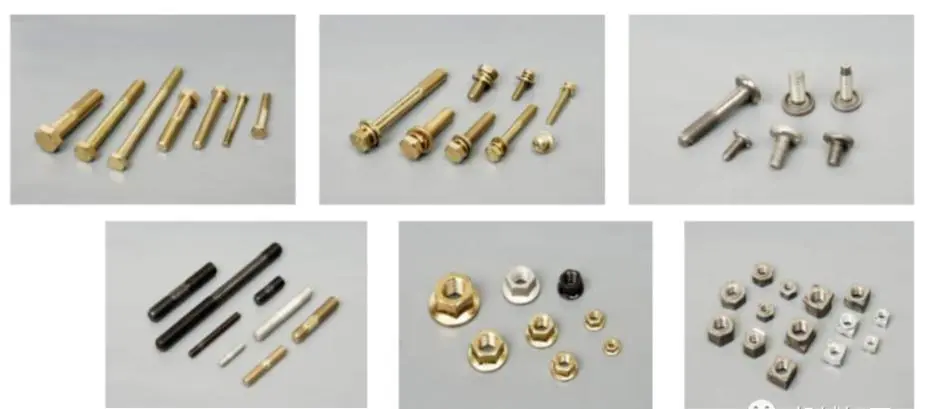
Common bolts, combined bolts with washers, stud bolts, welding bolts, self-tapping bolts Common nuts, locking nuts, welding nuts
II. Main Processing Steps of Bolts:
Steel material modification → Drawing → Cold heading (with washers) → Thread rolling → Heat treatment → Surface treatment → (Hydrogen removal) → Adhesive coating
Details of Each Step:
Steel material modification: Spheroidizing annealing (equivalent to stress relief and adjustment of metallographic structure), requires pickling and phosphating (for rust prevention).
Drawing: Cold drawing of steel to the required diameter.
Cold heading: Multi-station cold heading for forming.
4. Thread Rolling/Forming: Thread Forming
For combined bolts, washers must be assembled before thread processing. Error-proofing is essential.
Thread rolling offers high efficiency, while thread forming is mainly used for slender bolts or when high precision in thread positioning is required.
Attention should be paid to thread profile and potential surface folding defects.
5. Heat Treatment: Mesh Belt Furnace Process
Remove phosphating coating (to prevent phosphorous embrittlement), followed by cleaning, drying, heating, cooling, and tempering.
Key parameters: time and temperature. Control stacking height of bolts during the process.
This step determines bolt properties such as hardness and tensile strength, corresponding to the bolt grade. Common grades include 6.8 and below, 8.8, 10.9, and 12.9.
In the grade designation, the first number indicates the tensile strength (e.g., 8 represents 800 N/mm²). The product of the two numbers represents the yield strength (e.g., 800 × 80% = 640 N/mm² for grade 8.8).
I. Several Main Types of Fasteners for Vehicles:
Common bolts, combined bolts with washers, stud bolts, welding bolts, self-tapping bolts Common nuts, locking nuts, welding nuts
II. Main Processing Steps of Bolts:
Steel material modification → Drawing → Cold heading (with washers) → Thread rolling → Heat treatment → Surface treatment → (Hydrogen removal) → Adhesive coating
Details of Each Step:
Steel material modification: Spheroidizing annealing (equivalent to stress relief and adjustment of metallographic structure), requires pickling and phosphating (for rust prevention).
Drawing: Cold drawing of steel to the required diameter.
Cold heading: Multi-station cold heading for forming.
4. Thread Rolling/Forming: Thread Forming
For combined bolts, washers must be assembled before thread processing. Error-proofing is essential.
Thread rolling offers high efficiency, while thread forming is mainly used for slender bolts or when high precision in thread positioning is required.
Attention should be paid to thread profile and potential surface folding defects.
5. Heat Treatment: Mesh Belt Furnace Process
Remove phosphating coating (to prevent phosphorous embrittlement), followed by cleaning, drying, heating, cooling, and tempering.
Key parameters: time and temperature. Control stacking height of bolts during the process.
This step determines bolt properties such as hardness and tensile strength, corresponding to the bolt grade. Common grades include 6.8 and below, 8.8, 10.9, and 12.9.
In the grade designation, the first number indicates the tensile strength (e.g., 8 represents 800 N/mm²). The product of the two numbers represents the yield strength (e.g., 800 × 80% = 640 N/mm² for grade 8.8).